
Introduction
Squat is one of the most critical hydrodynamic effects a navigating officer must understand when sailing in shallow or confined waters. Incorrect squat estimation has resulted in groundings across the world, including the Suez Canal, St. Lawrence River, and multiple river and harbour approaches. When a vessel moves through water, pressure changes around the hull cause the ship to sink slightly deeper and often trim by the bow. This phenomenon is known as squat. The reduction of under keel clearance (UKC) due to squat must be accounted for in passage planning, tidal calculations, and restricted-water navigation.
What Is Squat?
Squat is defined as the combination of sinkage and trim that occurs when a ship moves ahead in shallow or confined waters. Sinkage is the downward vertical movement of the vessel’s hull. Trim change is usually a forward trim, where the bow experiences a greater downward movement. Squat increases the vessel’s effective draft and reduces its UKC, making it a major safety consideration.
Why Squat Occurs
As the ship moves forward, water must flow around and under the hull. This flow accelerates in shallow water, causing a pressure drop around the vessel according to the Bernoulli principle. The reduction in pressure effectively pulls the ship downward, increasing sinkage and trim. The shallower or more confined the water, the greater the acceleration and hence the greater the squat.
Key Factors Affecting Squat
Squat is influenced heavily by speed, and its effect rises exponentially. A vessel at 12 knots will experience roughly four times the squat compared to the same vessel at 6 knots. Water depth plays a major role, with the effect becoming much more pronounced as depth decreases. The cross-sectional area of a channel, especially dredged or narrow channels, increases the blockage effect and results in greater squat. A ship with a high block coefficient (CB), such as a loaded bulk carrier or tanker, will experience more squat compared to a fine-form hull like a container ship. Trim condition and proximity to riverbanks also contribute.
Where Squat Is Highest
Squat is highest in shallow restricted waters such as river approaches, harbour channels, dredged canals, and narrow waterways. In these regions, blockages are higher and water flow is more constrained. Full-form ships typically experience greater bow squat, while some fine-form ships may experience stern squat depending on hull design.
Practical Squat Calculation Formula
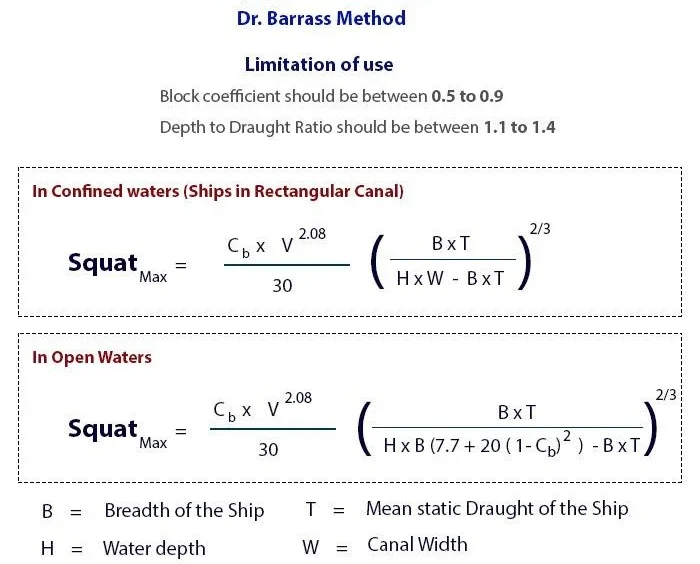
The most commonly used empirical formula onboard for open shallow waters is:
Squat (m) = C × (V² / 100)
Where C is determined from block coefficient (CB) and V is speed in knots.
Typical C values are: 1.0 for very full form ships (CB > 0.85), 0.8 to 0.9 for bulk carriers (CB 0.80–0.85), and 0.7 for fine-form ships (CB < 0.80).
For confined waters such as rivers and canals, squat effectively doubles and the formula becomes:
Squat (m) = 2 × C × (V² / 100)
Example 1: Squat in Open Shallow Waters
Consider a capesize bulk carrier with speed 12 knots, CB = 0.85, so C = 0.9, and water depth 20 m.
Step 1: V²/100 = 12² / 100 = 144/100 = 1.44
Step 2: Squat = 0.9 × 1.44 = 1.30 m
The ship will sink an additional 1.3 m due to squat. With a static UKC of 1.8 m, the remaining UKC becomes only 0.5 m, which is unsafe.
Example 2: Effect of Reducing Speed
Taking the same vessel at 8 knots:
V²/100 = 64/100 = 0.64
Squat = 0.9 × 0.64 = 0.58 m
Reducing speed from 12 to 8 knots decreases squat from 1.30 m to 0.58 m. This illustrates why pilots frequently instruct vessels to reduce speed when entering shallow water.
Example 3: Squat in Confined Channels
A Panamax bulk carrier moving at 10 knots with CB 0.82 (C = 0.85) in a confined channel:
Step 1: V²/100 = 100/100 = 1.0
Step 2: Squat = 2 × 0.85 × 1 = 1.7 m
A squat of 1.7 m at just 10 knots is significant. If the planned UKC is 1.5 m, the vessel will ground. This emphasises the need for drastic speed reductions in canals and rivers.
Bow and Stern Squat Distribution
For full-form ships like bulk carriers and tankers, approximately 70 percent of the total squat occurs at the bow and 30 percent at the stern. In Example 1, total squat = 1.3 m. Bow squat = 0.91 m and stern squat = 0.39 m. Fine-form ships may show a different distribution, occasionally experiencing stern-dominant squat.
Effect of Trim Before Entering Shallow Waters
A vessel trimmed by the stern will generally experience less bow squat, creating a more favourable trim for shallow-water transits. Excessive bow trim before entering shallow water can increase the total forward draft dangerously. Masters and navigating officers must ensure trim optimisation is part of the passage plan when transit through shallow or constrained areas is expected.
Operational Guidance for Navigators
Maintain the lowest safe speed compatible with steering and traffic. Always calculate squat for the highest transit speed expected in the passage plan. Follow port authority guidelines, as many ports publish squat tables for their channels. Be cautious near riverbanks, as bank effect increases turning tendencies and may combine with squat to reduce UKC further. Closely monitor echo sounders, speed, and ship response during shallow-water navigation. Include squat in UKC calculations along with heel due to turning, wave response, and tidal variations.
Conclusion
Squat is a critical hydrodynamic effect that directly influences navigational safety in shallow and confined waters. Understanding squat, calculating it correctly, and applying the appropriate reduction in speed can prevent groundings and enhance safety margins dramatically. By integrating squat calculations into the passage plan and bridge team discussions, ship officers can maintain safe UKC and ensure smooth navigation through challenging waterways.