

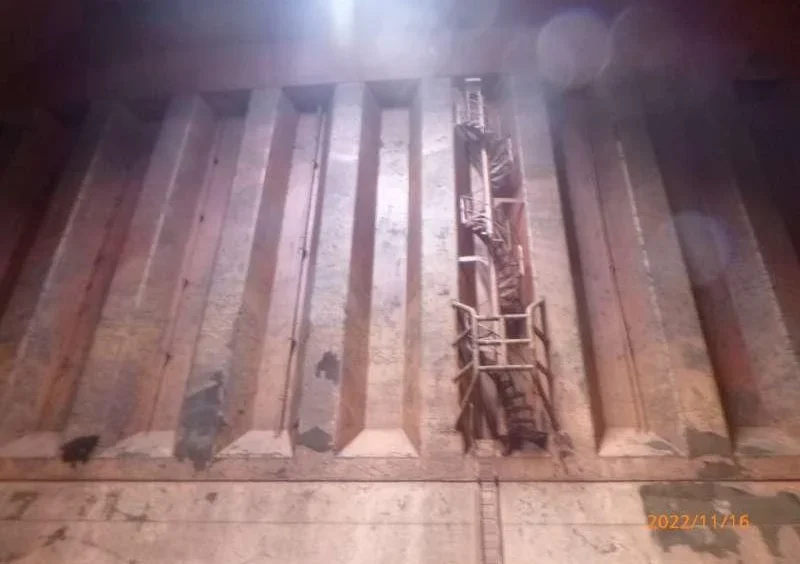
Corrugated bulkheads are a common structural feature inside bulk carrier cargo holds. Their folded, wavy appearance may seem simple, but the engineering behind them is highly specialised. Corrugation improves strength, reduces maintenance, and ensures that the bulk carrier can safely carry dense cargoes such as iron ore, coal, grain, bauxite, and fertilisers. This blog explains the concept in a practical way for cadets, officers, chief officers, and anyone working in technical or inspection roles.
What Are Corrugated Bulkheads?
Corrugated bulkheads are vertical bulkhead plates shaped with alternating ridges and grooves. Unlike flat bulkheads that depend on horizontal and vertical stiffeners, corrugated bulkheads are self-stiffening. Their geometry gives them inherent strength and rigidity, allowing them to absorb high pressures from bulk cargo and dynamic loads at sea.
Most bulk carriers use corrugated bulkheads for the transverse bulkheads separating cargo holds. The forward and aft bulkheads may be flat-stiffened, but the internal cargo hold boundaries are commonly corrugated.
Why Are Bulkheads Corrugated?
Self-Stiffening Strength
The corrugation acts like a series of built-in stiffeners. This reduces the need for brackets, beams, and longitudinal stiffeners. Fewer welded joints also mean fewer stress concentrations and fewer crack-prone areas.
Better Load Distribution
Corrugated bulkheads distribute loads evenly. When the ship pitches, rolls, or is loaded heavily, pressure is transferred smoothly across the entire plate. The shape prevents buckling and distortion much better than a flat plate.
Reduced Maintenance
Since there are no stiffeners, there are no complicated hard-to-reach spaces where corrosion can start unnoticed. Corrugated bulkheads are easier to clean, inspect, and maintain.
Better Cargo Flow
The sloped nature of certain corrugated shapes helps cargo flow during discharge. It reduces hang-ups and cargo accumulation.
Types of Corrugated Bulkheads
Vertical Corrugation
This is the most common type. Corrugation runs from the tank top to the upper deck. It maximises strength against transverse pressures from cargo.
Horizontal Corrugation
Used less frequently. Corrugation runs horizontally, offering advantages for certain cargo types but making cleaning and scaling more difficult.
V-Shaped Corrugation
A symmetrical corrugation pattern shaped like a series of repeating V’s. It provides strong resistance against compressive loads.
U-Shaped Corrugation
A smoother pattern that offers good strength but slightly lower rigidity compared to V-shaped forms.
Structural Behaviour of Corrugated Bulkheads
Resistance to Cargo Pressure
When thousands of tonnes of iron ore are loaded, the pressure on the bulkhead increases significantly at the lower sections. Corrugation helps resist this pressure without deforming.
Distribution of Hull Stresses
While the ship bends, hogs, or sags, the bulkhead flexes slightly. This controlled flexibility prevents cracks.
Elimination of Stiffeners
A flat plate needs stiffeners to avoid buckling. Corrugation removes the need for them, simplifying the entire structure.
Fatigue Performance
The shape reduces stress concentration, improving fatigue life and lowering the chance of crack propagation.
Where Are Corrugated Bulkheads Used?
In most bulk carriers, corrugated bulkheads are used at the:
Intermediate cargo hold bulkheads
Side shell connections
Topside and hopper transitions
Lower stool and upper stool areas
Typical Inspection Areas on Corrugated Bulkheads
During PSC, RightShip, class, or internal inspections, the following areas are given maximum attention:
Corrugation Valleys and Crowns
These areas are prone to impact damage from grabs during loading. Inspect for dents, cracks, gouges, and deformation.
Lower Stool and Tank Top Connections
The transition from corrugation to flat plate is a high-stress region. Check for:
Cracks in welds
Corrosion
Indentations
Wastage
Upper Stool Area
Cracks may occur where the corrugated bulkhead meets the deck structure.
Weld Seams
Welds along the corrugation fold lines may develop hairline cracks, especially on older vessels.
Coating Condition
Poor coating leads to pitting corrosion, especially in cargoes like coal, fertilisers, and sulphur.
Water Ingress Paths
Look for leakage signs where the bulkhead connects to:
Side shell
Hopper tank
Topside tank
Double bottom tank
Common Defects in Corrugated Bulkheads
Cracks at the transition area
Indentations caused by grabs
Wastage and corrosion in the troughs
Buckling due to overloading
Pitting corrosion near brackets and corner joints
Coating breakdown due to aggressive cargoes
Maintenance and Repair Considerations
Regular Descaling and Cleaning
Rust scales can hide cracks and thinning. Clean before inspections.
Spot Repairs
Small cracks can be repaired with controlled hot work. Ensure all work complies with class procedures.
Coating Renewal
Cargo holds should be freshly coated during drydock to maximise protection. Use wear-resistant coatings.
Avoid Overloading
Follow loadicator limits. Overloading causes long-term distortion.
Monitoring Grab Operations
Grabs should not hit the bulkhead repeatedly. Use experienced crane operators.
Safety Practices During Inspection of Corrugated Bulkheads
Gas testing before entry
Good lighting
Proper communication between deck and hold
Inspection from safe platforms or ladders
Avoid walking under suspended cargo during discharge
Use of fall arrestors where necessary
Advantages of Corrugated Bulkheads at a Glance
High structural strength
Reduced need for stiffeners
Simplified construction
Lower maintenance
Improved durability
Better cargo flow and cleaning
Improved fatigue performance
Conclusion
Corrugated bulkheads are an essential structural feature of bulk carriers. Their design combines strength, simplicity, and durability, making them better suited for heavy and abrasive bulk cargoes. A good deck officer must understand how they behave under load, where typical defects occur, and how to inspect them properly. Mastery of corrugated bulkhead inspection not only ensures safety and compliance but also prevents costly structural failures.