
Introduction
A barometer is one of the most essential meteorological instruments carried on board every seagoing vessel. It measures atmospheric pressure and gives the officer valuable information about changing weather patterns, approaching storms, cyclonic activity, frontal systems, and general atmospheric behaviour. Long before electronic forecasts and satellite charts became common, mariners relied heavily on barometers, and even today, barometer trends remain a critical part of safe navigation, voyage planning, and heavy weather avoidance. Understanding how a barometer works, how to read it, and how to interpret pressure changes allows officers to make informed decisions at sea.
What Is a Barometer?
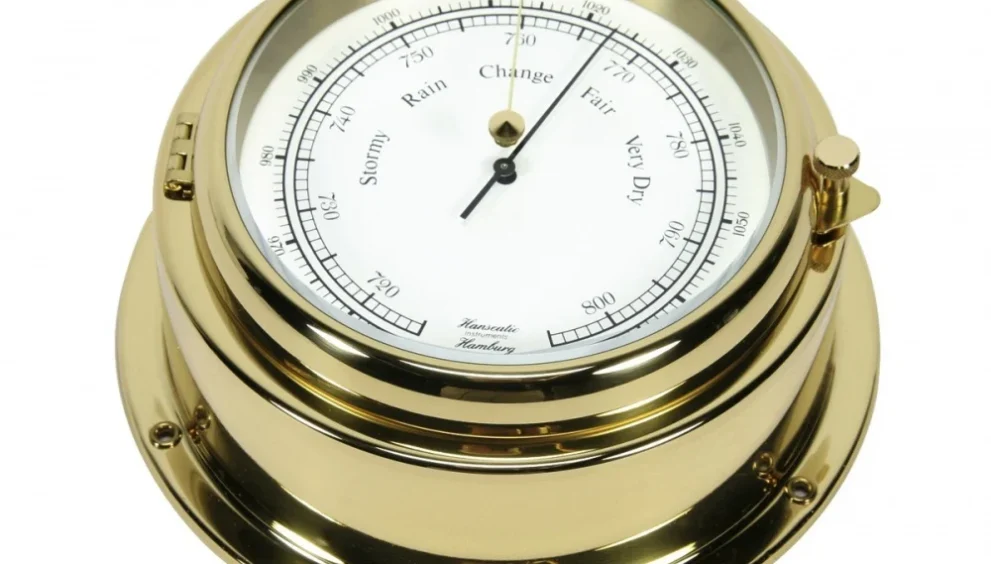
A barometer is an instrument used to measure the pressure exerted by the atmosphere at a particular location. Atmospheric pressure varies with temperature, wind, and weather systems. By monitoring these variations, officers can identify whether weather is likely to improve or deteriorate. A rapid fall in pressure usually signals the approach of a depression or storm, while rising pressure indicates improving or settled weather. On ships, barometers are normally installed near the chart table or bridge area for easy access during watchkeeping.
Types of Barometers on Ships
The aneroid barometer is the most widely used type onboard. It contains a sealed, flexible metal capsule that expands or contracts depending on atmospheric pressure. This movement drives a mechanical linkage connected to a pointer on a dial. It is simple, reliable, and suitable for shipboard use. Another type is the barograph, which is essentially an aneroid barometer with a recording mechanism. It uses a drum and paper chart to record pressure continuously over time. This recorded trend is extremely useful for detecting pressure falls associated with deep lows, cyclones, or frontal passages. Mercury barometers were historically used due to their high accuracy, but they are rarely carried now because they are sensitive to ship motion and mercury is restricted under modern safety and environmental rules.
Why the Barometer Is Important
The barometer helps officers forecast weather more accurately than by observation alone. A continuous pressure drop may indicate an approaching storm, while a rapidly rising pressure suggests the departure of a depression or the arrival of a high-pressure system. Pressure readings support safe navigation decisions, including altering course to avoid dangerous storm sectors, slowing down to reduce damage in heavy seas, or preparing the vessel for bad weather. Voyage planning also depends on pressure data because atmospheric systems influence expected winds, waves, swell direction, and sea state. Many ports and terminals require regular barometer entries in the log book, typically every three hours, because pressure data forms part of official meteorological reporting.
How to Read a Barometer
Reading a barometer involves observing the current pressure value and monitoring the pressure tendency, which indicates the rate of change over time. Officers always check both the absolute pressure and the trend. Common pressure units used onboard include millibars (mb) or hectopascals (hPa). If the barometer reading is stable and high, fair weather is likely. If the barometer falls steadily, it signals deteriorating conditions. A very rapid drop is often associated with strong winds, gales, or tropical cyclone formation.
Interpreting Pressure Changes
A slow fall in pressure may indicate a weak depression or gentle frontal system, with moderate winds and possible rain. A rapid pressure fall suggests a deepening low-pressure system bringing strong winds, rough seas, and heavy precipitation. A sudden rise in pressure after a storm indicates clearing skies but may also bring strong gusts as the system moves away. Very high pressure combined with clear skies can produce calm but cold air masses in winter. Low pressure signifies unstable weather, while high pressure signifies stable conditions.
Example: Using Barometer Trends for Weather Prediction
If the barometer drops from 1012 hPa to 1004 hPa over six hours, the pressure has fallen by 8 hPa. This indicates a strong depression approaching, and the officer should expect deteriorating weather, likely increasing winds from a predictable direction based on Buys Ballot’s law. In another case, if pressure rises from 1000 hPa to 1010 hPa after a storm, improving conditions can be expected, though residual swell may continue for several hours.
Barometer and Heavy Weather Avoidance
A barometer is vital when navigating cyclone-prone areas. Tropical cyclones are associated with extremely low pressures. A rapid fall in pressure is often the earliest warning sign of a developing or approaching cyclone. Officers can use pressure trends, combined with wind shifts and cloud patterns, to determine whether the ship is in the dangerous semicircle, navigable semicircle, or path of the storm. This allows timely course alteration or speed reduction to stay clear of the cyclone’s core.
Barometer Use in Routine Watchkeeping
Every watchkeeper must monitor and log barometer readings regularly. During bridge watches, the officer should check and record pressure every hour during critical weather situations and every three hours during normal conditions. Trend arrows or notes should be added, indicating rising, steady, or falling pressure. These entries help track weather progression and assist the master in decision-making.
Factors That Affect Barometer Accuracy
Ship motion may cause minor fluctuations, particularly in heavy seas, but the aneroid mechanism helps reduce such effects. Temperature variations can affect readings slightly, and most modern barometers include temperature compensation. Barometers must be calibrated periodically, and comparisons with meteorological forecasts ensure that the instrument remains accurate.
Conclusion
A barometer is one of the most critical weather instruments on board a ship. By measuring atmospheric pressure and monitoring its trend, deck officers can predict weather changes, avoid dangerous systems, prepare the vessel for heavy weather, and ensure safe navigation. Even with advanced satellite forecasts and digital weather routing, barometer observations remain a fundamental part of marine meteorology and seamanship. Every navigating officer should understand how to read, interpret, and use barometer information effectively to maintain safety and operational efficiency at sea.