

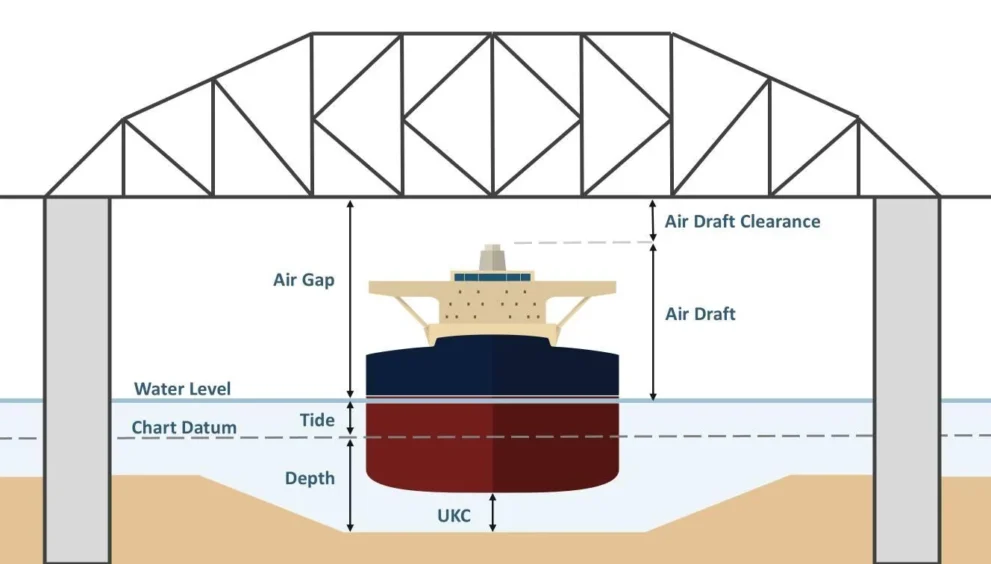
Air draft is one of the most important but often underestimated parameters in ship navigation, especially when passing under bridges, overhead power lines, gantry cranes, loading booms, and port structures. A miscalculation of air draft can result in catastrophic damage, delays, structural failure, and even grounding-like incidents when the mast or funnel strikes an overhead obstruction.
This blog explains air draft from A to Z in simple, practical language for ship officers, covering definitions, calculation methods, influencing factors, operational risks, and real-world applications.
What is Air Draft
Air draft is the vertical distance from the waterline to the highest fixed point on the vessel. This highest point may be the masthead, radar scanner, funnel top, light pole, derrick head, crane boom (when stowed), or communication antenna, depending on the ship’s configuration.
In simple terms, air draft tells you how tall the ship is above the water.
Why Air Draft Is Important
Air draft is critical because it determines whether a ship can safely pass under:
Bridges
High-voltage power lines
Loading booms
Container cranes
Offshore terminals
River bridges
Lock entrances
If air draft is miscalculated, even by a small margin, the highest structure of the ship can collide with overhead structures, causing heavy structural damage or total loss of navigational equipment.
Components of Air Draft
Air draft depends on two main vertical measurements:
- Height of the highest point above the keel
- Draft of the vessel
The basic relationship is:
Air Draft = Height of highest point above keel minus Draft
This gives the distance from the waterline to the highest ship structure.
How to Calculate Air Draft
There are two ways to calculate air draft:
Using known vessel data
Using actual measured draft at the time of calculation
The general formula is:
Air Draft = Height of highest point above keel Actual draft
Example:
Highest point above keel: 52 metres
Draft forward: 13.0 metres
Draft aft: 14.0 metres
Mean draft: 13.5 metres
Air Draft = 52 – 13.5 = 38.5 metres
This means the ship extends 38.5 metres above the water.
Why Mean Draft Is Used
Mean draft is used because air draft represents the ship’s overall height, independent of trim. However, if the highest point is toward the bow or stern, officers may adjust the draft reference accordingly.
Example:
If the mast is forward, use forward draft for more accuracy.
Factors Affecting Air Draft
- Draft and displacement
The heavier the ship, the deeper it sits, reducing air draft.
A ballasted ship with small draft has a higher air draft. - Trim
Trim affects which draft value should be used when calculating air draft near a specific location on the ship. - Water density
Salt water increases buoyancy; fresh water decreases buoyancy.
In fresh water, ships sink deeper, reducing air draft. - Tides
Higher tide reduces air draft clearance under bridges.
Lower tide increases available clearance. - Load condition
Loaded condition reduces air draft.
Ballast condition increases air draft. - Sag and hog
In rare cases, hull deflection in long vessels affects local draft values.
Air Draft and Bridge Clearance
For safe passage under bridges, clearance must be assessed accurately.
Clearance required = Air Draft + Safety Margin
Ports normally specify minimum safety margins, often between 1 metre and 2 metres depending on:
Swells
River current
Wind
Dynamic heel
Navigational accuracy
Always refer to port guidelines before transit.
Air Draft Restrictions in Ports
Some terminals have strict air draft limits due to:
Loader or unloader booms
Overhead conveyor systems
Gantry crane rails
Loading arms in oil terminals
Shore cranes
Bulk carriers frequently encounter air draft restrictions when loading or discharging.
Air Draft in Rivers and Canals
Narrow inland water systems have many fixed bridges with different height clearances. Ships must be planned for:
Tide effects
River level rise during monsoon
Wind-induced heeling
Squat in shallow areas causing deeper draft
All these influence air draft planning.
Dynamic Air Draft
Dynamic air draft considers the influence of:
Ship rolling
Pitching
Heeling due to wind
Ballast operations
Trim changes during cargo operations
Dynamic air draft is important when passing very close to limits, especially when the clearance is less than 1 metre.
Understanding Highest Point on the Vessel
The highest point may change depending on:
Mast height
Antenna installations
Crane booms
Funnel height
Navigation light mounts
Radars when lifted
Officers must check the general arrangement plan to verify the correct tallest point.
Reference Plans Used for Air Draft
General arrangement plan
Capacity plan
Lines plan
As-built drawings
Stowage plans showing crane positions
These plans help identify the highest permanent structure.
Common Mistakes in Air Draft Calculation
Using wrong draft (using observed draft instead of mean draft)
Not checking if the mast or antenna is actually the tallest point
Ignoring tidal effects
Not considering freshwater density
Not accounting for dynamic motions during transit
Relying on outdated charts or bridge height values
Assuming clearance without verifying port limits
Incorrectly reading bridge clearance (from water surface or chart datum)
Every mistake can lead to dangerous misjudgement.
Air Draft and Tidal Windows
Many ports provide tidal windows for ships with high air draft. Officers must calculate:
Air Draft at different drafts
Predicted tidal heights
Bridge clearance at highest tide
Safety margin
A ship may need to wait for low tide to safely pass under a bridge.
Air Draft During Cargo Operations
Air draft can change significantly during cargo operations.
When loading:
Draft increases
Air draft decreases
Clearance under shore cranes may increase
When discharging:
Draft decreases
Air draft increases
Risk of touching crane booms becomes higher
Deck officers must monitor drafts continuously during operations.
Air Draft in Ballast Condition
Ballast condition usually gives the highest air draft. This is critical when:
Entering rivers
Passing beneath bridges
Approaching floating cranes
Aligning under grab unloaders
Ballast exchange operations also affect draft and must be controlled when approaching air draft limits.
Operational Checklist for Air Draft Safety
Confirm highest point from GA plan
Measure ship’s actual drafts
Calculate air draft before entering restricted areas
Verify bridge clearance from official sources
Apply tide corrections
Include safety margin
Consider dynamic movements
Keep engines ready and maintain slow speed
Ensure bridge team is briefed
Maintain communication with pilots
Real Incidents Related to Air Draft
Vessels hitting bridges due to miscalculated air draft
Mast collision with power lines causing blackout
Container ships striking gantry boom during berthing
Bulk carriers damaging loader booms due to high air draft during discharge
Navigation radars destroyed by low bridge clearance
All these highlight the importance of accurate air draft planning.
Conclusion
Air draft is a critical parameter for safe navigation under bridges, power lines, cranes, and port installations. Every officer must understand how to calculate it accurately and consider all influencing factors such as draft, tide, water density, and dynamic motion. Proper air draft calculation prevents structural damage, delays, costly repairs, and navigational accidents.
Air draft planning should always be included in passage planning, pilot briefing, and cargo operation procedures.