

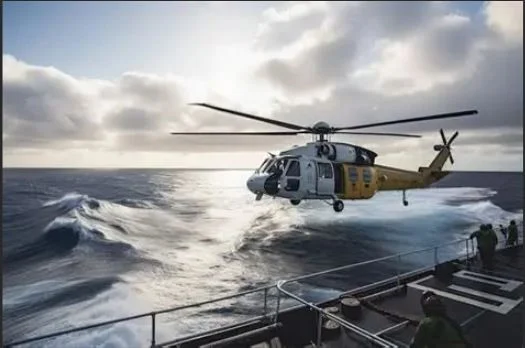
Maritime helicopter operation, or helicopter operation at sea, is accompanied by strict safety procedures and coordination. This entire guide encompasses safety precautions, operational planning, communication, and an actual shipboard helicopter checklist for secure and effective helicopter operations at sea.
Introduction
Helicopter operation at sea is a precision-reliant, high-risk operation that needs thorough planning and execution. Helicopter operations are employed for:
Medical evacuation (MEDEVAC)
Helicopter pilot transfer in case boarding the ship is unsafe
Crew change out to an isolated location
Transfer vital spares, papers, or stores from shore to ship
Search and Rescue (SAR)
If planning or communication goes off track, it can lead to some serious trouble — rotor wash hazards, moving loads, even a helicopter going down. That’s why every flight has to stick to a proper checklist, step by step, and be handled by a crew that actually knows the work and has the training for it.
Pre-Operation Planning
Before a helicopter even approaches the ship:
Confirm ETA and type of operation with the helicopter operator.
Exchange wind, weather, and sea condition data.
Agree on VHF channel for final approach and landing (usually Ch. 16 + a working channel).
Select deck area (helideck or a cleared space) and prepare it.
Adjust ship’s heading to give the helicopter relative headwind.
Safety Precautions
PPE: helmet with chin strap, goggles, hearing protection, gloves, lifejacket.
No loose objects or debris on deck.
Approach helicopter only from the front in full view of the pilot.
For night ops — use appropriate lighting but avoid blinding the pilot.
Fire party on standby with foam applicators and extinguishers.
Types of Helicopter Operations
Landing on Deck – requires helideck or clear space.
Hover and Winch – for MEDEVAC or transfer without landing.
Sling Load Delivery – for cargo or stores.
Your Real-World Shipboard Helicopter Operations Checklist
- Preparation Before Arrival
- Inform crew and assign Helicopter Landing Officer (HLO).
- Conduct toolbox talk and explain roles to all involved.
- Check wind and weather limits for operation.
- Prepare landing/winch area — clear, clean, and free of loose gear.
- Brief medical team if MEDEVAC.
- Deck Preparation
- Secure all equipment and lash down loose covers.
- Mark safe approach and exit paths with tape or paint.
- Position firefighting equipment (foam, extinguishers).
- Establish primary and backup communication channels.
- Ensure stretcher is ready if MEDEVAC.
- During Helicopter Approach
- Maintain steady course and speed as per pilot’s instructions.
- Give relative wind direction for safe approach.
- HLO to provide hand signals — only one person signals to pilot.
- Keep non-essential crew clear of operations area.
- Monitor for foreign object debris (FOD) blown by rotor wash.
- During Winching / Transfer
- Never touch the winch cable until it contacts the deck (discharge static electricity).
- Guide load or stretcher away from swinging motion.
- Keep body low, stay clear of rotors at all times.
- Post Operation
- Clear deck and secure equipment.
- Log operation in deck logbook with time, type, and any remarks.
- Report completion to company as per SMS.
- File any safety observations or non-conformities.
Communication & Signals
VHF: Ch. 16 for initial, then switch to agreed working channel.
Hand Signals:
Clear to land – arms raised above head.
Hold – arms extended horizontally.
Wave-off – arms crossed above head.
Emergency Procedures
Crash on Deck – Sound general alarm, firefighting team to respond with foam.
Man Overboard – Stop heli-ops, mark position, initiate MOB recovery.
Rotor or Sling Failure – Clear deck and follow pilot’s instructions.
Best Practices
Conduct regular heli-ops drills during training schedules.
Abort if safety is doubtful — never take chances.
Keep all records and reports complete — important for audits and investigations.
Conclusion
Helicopter operations at sea demand coordination, discipline, and situational awareness.
By following a clear, step-by-step checklist like the one above, you reduce risk, protect lives, and ensure the operation’s success — whether it’s a MEDEVAC, stores delivery, or SAR mission.
References
ICS Guide to Helicopter Ship Operations
Ship Fire Fighting Manual and SMS