

Understanding the requirements of MARPOL Annex V and knowing what PSC inspectors look for in the Garbage Management Plan, Record Book, and on-board segregation is key to ensuring compliance.
Introduction
Although garbage disposal may seem like a simple task, it is a common area where ships fail to meet the required standards.
PSC inspectors frequently find non-compliance in this area.
The Garbage Management Plan and Record Book of a ship are important indicators of how seriously the vessel follows MARPOL Annex V, a regulation designed to protect the oceans from pollution caused by waste from ships.
This article explains in simple terms what PSC inspectors are looking for and how officers can stay fully compliant.
MARPOL Annex V The Foundation
MARPOL Annex V prohibits the disposal of garbage into the sea unless under very strict conditions.
Every ship of 100 GT and above, or certified to carry 15 persons or more, must be equipped with:
- A written Garbage Management Plan approved by the flag state.
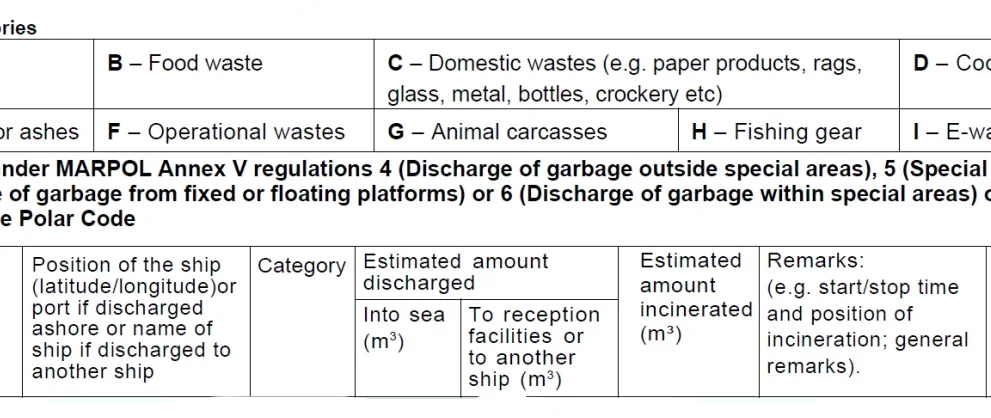
- A Garbage Record Book to record all garbage discharges and deliveries.
- Proper segregation of garbage with clearly marked bins.
What the Garbage Management Plan Should Contain
According to IMO Resolution MEPC.295(71), the Garbage Management Plan (GMP) should clearly describe:
– Methods for reducing, collecting, sorting, treating, and disposing of waste.
– The designated person responsible for carrying out the plan.
– The location of bins, compactors, incinerators, and storage areas.
– Disposal methods, including ash, food waste, plastics, paper, dunnage, and cargo residues.
– Instructions on how to keep records in the Garbage Record Book.
– References to placards or posters that explain the disposal rules.
The GMP should be written in a language the crew understands and be readily available for inspection.
What PSC Inspectors Usually Check
- Garbage Record Book Entries
- Entries must be clear, complete, and signed by the officer in charge.
- Each page must be signed by the Master.
- PSC inspectors will compare the entries with discharge receipts or incinerator logs.
- There should be no records indicating illegal waste released into the ocean, especially plastics.
Garbage Segregation and Bin Labels
Inspectors check the accommodation, galley, and deck areas.
Bins should be color-coded and labeled, such as for plastics, food waste, metals, and glass.
Common issues include incorrect or faded labels.
Storage and Handling
The garbage room should be clean, well-ventilated, and covered.
Inspectors look for signs of leakage or overflow.
Food waste should not be mixed with dry garbage.
Delivery Receipts to Port Reception Facilities
PSC inspectors check if receipt documents for landed garbage are kept onboard for at least two years.
The quantities on the receipts must match the entries in the Garbage Record Book.
Crew Awareness
PSC officers often ask crew members questions, such as:
– Where is the Garbage Management Plan?
– What do you do with food waste?
If crew members can’t answer confidently, even if the paperwork looks good, it may raise suspicion.
Common PSC Deficiencies
Deficiency | Typical Observation
Obsolete Garbage Management Plan | Not reflecting current Master or ship layout
Wrong GRB postings | Dates missing, categories mixed
No segregation | All garbage in one bin
Missing posters | MARPOL placards not displayed in galley or mess
No disposal receipts | Last garbage landing not recorded
Best Practices for Officers
- Review the Garbage Management Plan during every familiarization and ensure your name is listed as the designated officer if assigned.
- When recording entries in the Garbage Record Book, cross-check them before the Master signs. Avoid errors or blanks.
- Keep bins properly marked and ensure lids are closed.
- Conduct regular training for galley staff and deck crew, who handle most of the garbage.
- Keep the garbage room clean, organized, and free of odors at all times.
- Store port receipts in a transparent file clearly labeled “Annex V Receipts.”
- Log incinerator hours if the incinerator is used.
Pro Tips
– Always ensure the version number of the Garbage Management Plan matches the one in SMS or the flag state’s approval letter.
– Food waste should never be discharged into the sea in special areas like the Baltic Sea or other MARPOL Special Areas.
– Use posters with pictures in the crew’s native language to assist new members.
– PSC inspectors often cross-check the date consistency between entries in the Oil Record Book (Annex I) and the Garbage Record Book (Annex V).