
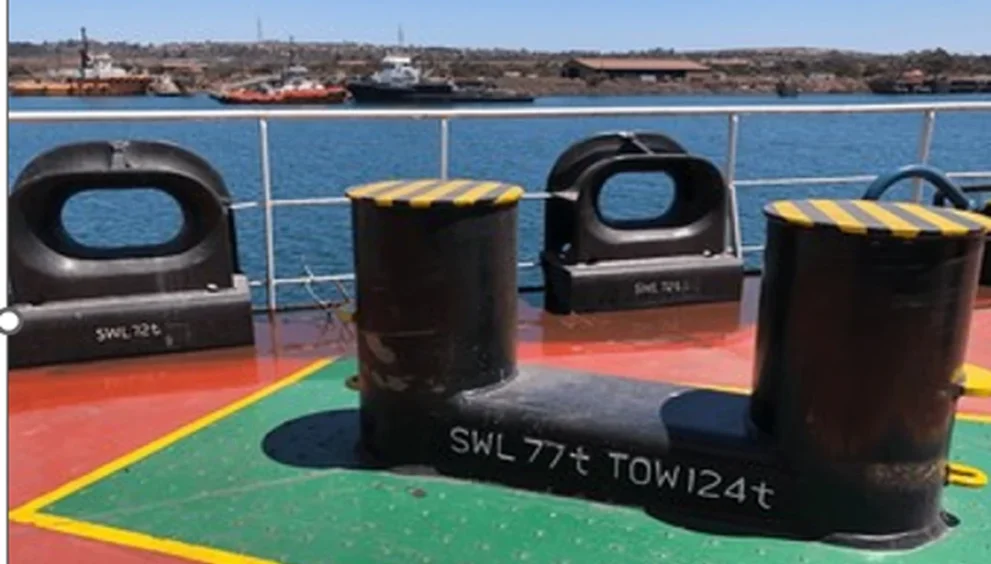
SWL stands for Safe Working Load. It is the maximum load that a piece of lifting equipment, rigging gear, or structural component can safely bear when used under normal operating conditions. SWL is determined by the manufacturer through testing and calculations, and it provides a safety margin to prevent overloading, equipment failure, and accidents during lifting operations.
Onboard ships, SWL is one of the most important markings for all lifting appliances and portable lifting gear because lifting operations take place frequently in deck work, cargo handling, engine room maintenance, and emergency operations.
Meaning of SWL
SWL represents the safe permissible load, not the ultimate breaking load. Every lifting item has a breaking load which is higher, but it is not used for practical operations. Instead, SWL is calculated as:
SWL = Breaking Load ÷ Safety Factor
The safety factor depends on the type of equipment and international regulations. This ensures the gear is never used near its breaking point.
Where SWL Is Found Onboard
SWL markings are placed directly on the equipment for quick identification. Common items include:
Ship’s cranes and derricks
Provision cranes
Lifeboat davits and launching appliances
Mooring winches and hooks
Lifting beams and spreaders
Cargo gear such as shackles, chain blocks, slings, and hooks
Engine room overhead girders and rail cranes
Man-riding equipment
Liferaft hoisting points
All SWLs must be clearly stamped, engraved, or painted on the equipment.
Importance of SWL on Ships
SWL ensures that lifting operations are carried out safely by preventing overloading.
It helps officers select the correct lifting gear for a job.
It reduces the risk of structural failure, injuries, and equipment damage.
It ensures compliance with SOLAS, ILO, Flag State rules, and the vessel’s SMS.
It provides a trusted reference during cargo handling and maintenance tasks.
How SWL Is Used Practically
Before any lifting operation:
Identify the load weight.
Select lifting gear with SWL equal to or greater than the load.
Check all shackles, slings, blocks, and hooks.
Ensure no gear is deformed, corroded, cracked, or worn.
Use correct angles and configurations, as lifting angles reduce SWL.
Follow the lift plan and toolbox meeting guidelines.
Example:
If lifting a 2-ton motor in the engine room, you must ensure the chain block, shackle, sling, and overhead girder all have SWL greater than 2 tons. If any one item is lower, the entire lifting operation becomes unsafe.
Lifting Angles and SWL Reduction
When slings are used at angles, the effective SWL decreases because tension in each sling increases.
For example:
A 2-ton sling used at a 60° angle may have a reduced safe capacity of around 1.73 tons.
A 2-ton sling used at a 30° angle may have a reduced capacity of around 1 ton.
This is why correct rigging plans are essential.
Proof Load Tests and Certification
All lifting appliances undergo periodic proof load testing.
Portable gear such as shackles, slings, and chain blocks must have valid certificates.
Cargo gear registers, Form A and Form B, must be updated.
Class surveyors normally witness proof load tests and verify SWL markings.
Common Mistakes to Avoid
Never guess the weight of a load; always confirm.
Never mix lifting gear with unknown or unreadable SWL markings.
Never use damaged, bent, corroded, or modified gear.
Never exceed SWL even by a small margin.
Never stand under a suspended load.
Conclusion
SWL is a fundamental safety element on all ships. It protects crew, cargo, and equipment by ensuring that all lifting operations stay within safe mechanical limits. Understanding SWL, using certified lifting gear, checking angle reductions, and following procedures are essential parts of seamanship and safe shipboard operations.