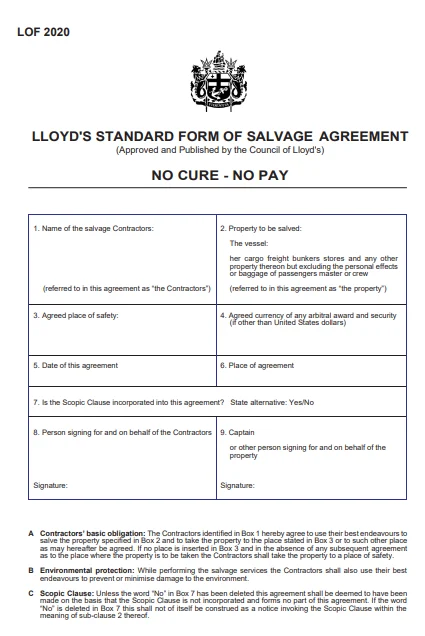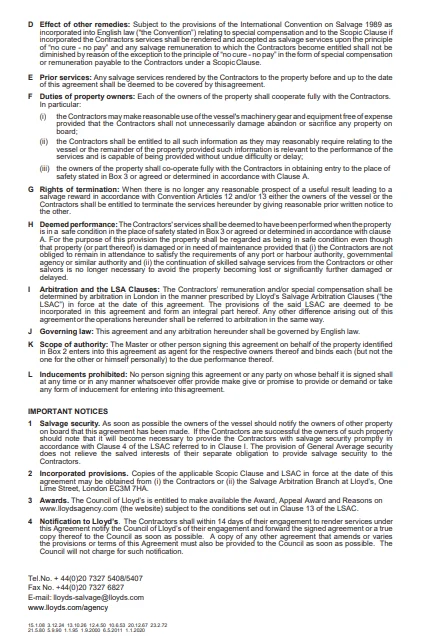

It provides all the necessary information needed to start a salvage mission without any delay. The form identifies the ship in trouble, the salvor helping, and the location and nature of the emergency. It also outlines that the salvage will be carried out under the “no cure, no pay” principle, meaning the salvor only gets paid if the operation is successful. Any disputes or reward amounts are decided by Lloyd’s arbitration in London. The form lists the specific services needed, such as towing, firefighting, pumping, or pollution control. Newer versions of LOF also allow for the use of SCOPIC, which is an alternative payment method that prioritizes environmental protection. Overall, LOF provides a simple, fast, and legally secure way for salvors to begin work right away while ensuring both sides are protected.
When a ship is in distress, there is no time to negotiate contracts or go through lengthy legal discussions.
Immediate action is required in cases like fires, grounding, collisions, or engine failures. In these high-pressure situations, the maritime world relies on a powerful tool that allows salvors to start their work instantly. This tool is the LOF, also known as Lloyd’s Open Form.
What is LOF in salvage?
LOF stands for Lloyd’s Open Form and is the most used emergency salvage contract in shipping.
It allows a shipowner and a professional salvor to quickly agree on the assistance needed without wasting time on lengthy negotiations. The ship’s master can simply say, “We agree to LOF,” and the salvage team can begin operations immediately.
LOF is governed by the 1989 Salvage Convention and is administered under the auspices of Lloyd’s Salvage and Arbitration Branch in London.
It has been used for over 100 years and it is the fastest way to start emergency salvage operations anywhere in the world.
The LOF Core Principle: No Cure, No Pay
The base of LOF is simple.
The salvor is only paid if the salvage is successful. The principle of “no cure, no pay” means:
The salvor needs to salve the ship, its cargo, or the environment to get paid.
The quantum of reward is determined later by independent Lloyd’s arbitrators.
Expenses paid by the shipowner are nil unless the operation is successful.
This, in turn, provides tremendous motive to the professional salvor to respond quickly with his best equipment and expertise.
Why LOF is still gold standard in maritime salvage
Immediate Response: Salvors can commence work in minutes, which is critical when lives, cargo, and coastlines are at risk.
Globally Accepted: Courts, insurers, flag states, and P&I clubs around the world trust LOF without hesitation.
Protects Shipowners : Costs subsequently determined by arbitration, therefore no unfair pricing.
Transparent and Fair : Lloyd’s arbitration ensures fairness and translucent decision-making.
Encourages Environmental Protection : Modern versions of LOF include SCOPIC, a clause that allows salvors to be paid even when the main goal is pollution prevention.
How LOF Works Step by Step
1.A vessel in distress declares an emergency.
2.LOF is accepted by the master or owner.
3.The salvor immediately deploys tugs and teams.
4.The service itself takes place, which includes firefighting, towing, pumping, refloating, and pollution control.
5.If successful, the reward is determined later through Lloyd’s arbitration.
Actual Examples that LOF Type Salvage Principles Played a Pivotal Role
Amoco Cadiz (1978)
One of the most notorious tanker disasters in history, the supertanker Amoco Cadiz suffered a steering failure off the coast of Brittany.
Strong ocean swells pushed the vessel toward the coast. Although LOF procedures were attempted, legal disputes with the towing tug delayed the response, and the vessel eventually grounded and broke apart. The result was one of the largest oil spills in history. This tragedy highlights the importance of fast acceptance of salvage terms like LOF. Delays can have serious consequences for coastlines, economies, and ecosystems.
Costa Concordia (2012)
After the cruise ship Costa Concordia ran aground off the coast of Italy, the salvage became one of the largest and most complex operations ever seen.
While not managed under a traditional LOF, the principles of rapid engagement and salvage reward were fundamental to the operation. The parbuckling refloat and removal took years and cost over a billion dollars, demonstrating the crucial role of professional salvage expertise after a disaster.
Ever Given (2021)
When the container ship Ever Given clogged the Suez Canal, the world supply chain ground to a halt.
Salvors quickly deployed tugs, dredgers, and heavy equipment to clear the blockage. Although this was not a LOF case, the situation highlighted the global importance of fast salvage response, which LOF is designed to support. Every hour mattered, and the principles behind LOF were reflected in the urgency of the operation.
Why Shipowners and Salvors Prefer LOF
Fastest Way to Start Work: LOF allows salvage operations to start work right away.
Legal Certainty : Accepted worldwide by courts, insurers, and other stakeholders with confidence.
Just Remuneration: Determined through neutral arbitration.
No Upfront Negotiation : There is no wastage of time in an emergency.
Supports Both Commercial Salvage and Environmental Protection : LOF encourages proactive measures to protect the environment and commercial interests. When LOF May Not Be Used For removal of planned wrecks. During non-emergency towage. When the shipowner and salvor already have a commercial contract. When the situation is stable and there is enough time to negotiate detailed terms.
Conclusion
LOF is the backbone of global maritime salvage because it delivers what ships need most during an emergency speed, simplicity, and certainty. The “no cure, no pay” principle ensures that salvors act quickly and professionally while protecting shipowners from unfair costs. Disasters like Amoco Cadiz, Costa Concordia, and Ever Given all highlight the importance of rapid professional salvage response. LOF remains one of the most important tools in keeping oceans safe and protecting global trade.