

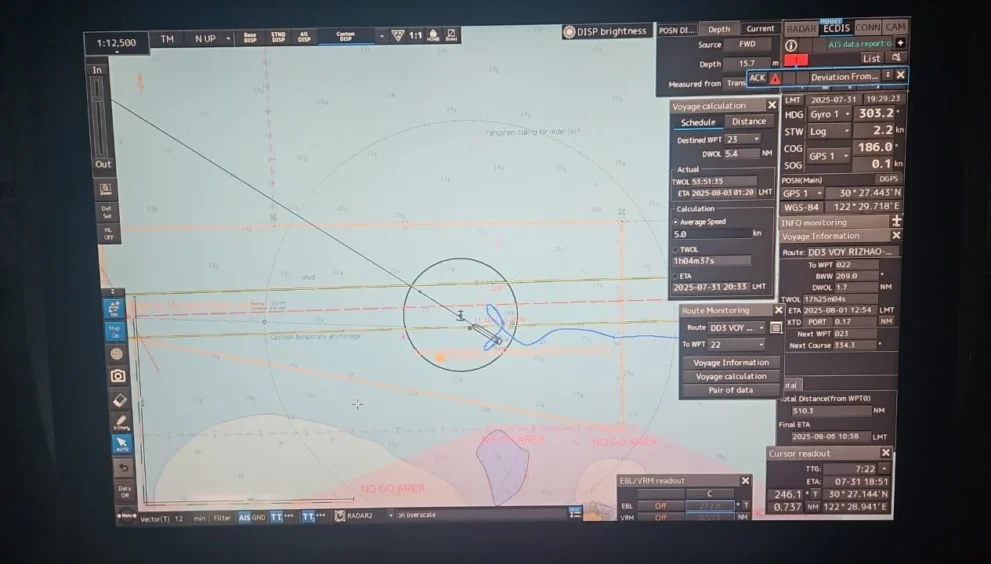
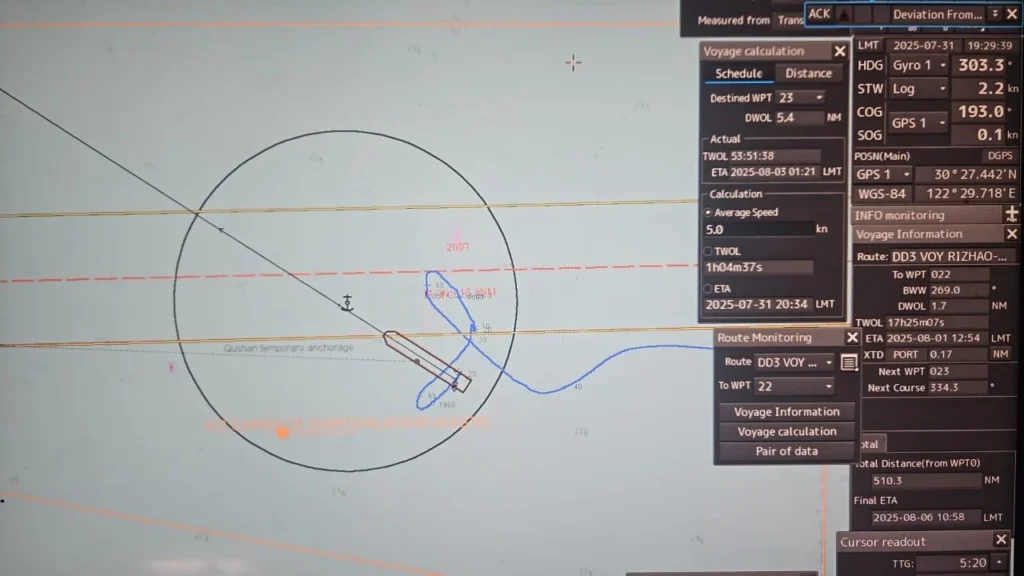
If you have ever stood on the bridge wing and observed the ship swing at anchor, you must have heard someone mutter, “We are still inside the anchor circle.” But what is this anchor circle? Why is it necessary? And how do you know if you are outside it?
Let’s learn this step by step.
The Basic Idea
When a vessel is anchored, it does not stay in one single position. The wind, current, and tide cause it to oscillate around the anchor. This oscillation occurs in a circular motion, with the centre being the anchor. The radius of this circle is approximately the amount of chain let out plus the length of the vessel. This theoretical circle around the anchor point is referred to as the Anchor Circle.
Therefore, in simple terms:
Anchor Circle = Anchor point as center + chain length + ship’s length = radius
Why is the Anchor Circle Significant?
- To track vessel movement: If your vessel leaves the anchor circle, it may indicate the anchor is dragging. It is a critical situation that requires prompt response.
- For navigational safety: It helps in planning your safe anchoring position. You make sure that your anchor circle does not overlap with other ships’ circles, shallow patches, wrecks, or navigational hazards.
- To set Anchor Watch Alarm: In ECDIS or GPS, we usually set an anchor watch alarm based on this circle. If the ship moves outside the preset limit, an alarm goes off.
- Port Authorities: Some ports ask for anchor position and the radius of the anchor circle in anchoring permits or pre-arrival information.
How is it Marked?
When you drop anchor, your GPS position at the time is noted. That is your anchor point. From this point, using a compass and range rings (on ECDIS or radar), you draw a circle using:
Length of cable paid out (in meters)
Plus the ship’s length from hawsepipe to stern
This gives you the anchor circle, which you monitor throughout the anchorage.
Example:
If you pay out 7 shackles (roughly 192.5 meters) and your ship’s length is 200 meters, your anchor circle radius is around 393 meters from the anchor point.
What Should Cadets and Junior Officers Know?
Always note the anchor drop position and log it.
Learn to mark anchor circle on ECDIS and paper chart.
Monitor vessel movement at anchor using GPS, radar, and visually.
Understand swinging room — your anchor circle should not touch others’.
Anchor circle is not the same as anchor swing circle used for navigational safety planning.
Final Words
An anchor circle is not just some theory from your nautical books. It is a real-time safety tool. It tells you where your ship is supposed to be while at anchor and warns you when something is wrong. As a cadet or officer, keeping track of the ship within this circle is your duty, especially during night watches or bad weather.
So next time you are on anchor watch, remember — if the ship is outside the anchor circle, the anchor might not be holding.
Stay alert, stay safe.