

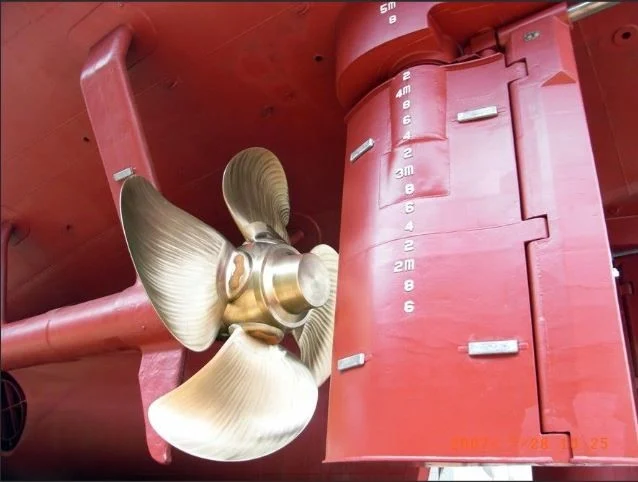
When most people imagine how a ship travels, their thoughts tend to head toward huge engines, propellers, or navigation systems. But hidden away near the back is much less glamorous but entirely essential equipment — the rudder.
It doesn’t get much attention, but without the rudder, steering a vessel would be nearly impossible. In this article, we’ll explore what the rudder does, how it works, and the different designs used on various types of ships across the maritime world.
What Exactly Is a Rudder?
A rudder refers to a flat, vertical surface mounted at the back of a vessel near the propeller. It is connected to the steering mechanism and swivels left or right to alter the course of the ship.
By changing the direction of the water passing by the hull, the rudder generates a turning moment which assists in turning the ship. This simple but effective mechanism enables even the biggest ships to react to minor helm movements.
How Does It Work?
When the rudder is turned, it deflects the water flow from the propeller. This deflection increases pressure on one side of the rudder and decreases pressure on the other, generating a sideways force that drives the stern.
Suppose the rudder is angled to the right (starboard): the stern moves left (port), and the bow turns to the right, causing the ship to turn starboard. The rudder works best because it relies so much on water flow — it works best when the ship is traveling forward and the propeller is generating thrust.
Why Is the Rudder So Important on Board?
Critical for turning: The rudder is used by ships to execute turns in a controlled manner, particularly during ports or in close-quarter manoeuvres.
Safety mechanism: In emergencies, a sudden rudder response helps steer clear of obstacles or quickly change direction.
Course correction on long voyages: On long voyages, the rudder corrects even slight course deviations — often via autopilot corrections.
Variations of Rudders on Ships
There are different rudder designs to suit different vessels — based on their size, speed, handling requirements, and mode of operation. Listed below are some of the most prevalent designs:
1. Balanced Rudder
This rudder possesses a segment of its surface forward of the pivot point (rudder stock), which counteracts the water pressure on both sides. Owing to such a configuration, the rudder requires less effort to be shifted.
Pros: Less steering power required, efficient
Cons: Can be damaged at the front during grounding
Generally used on: General cargo ships, tankers, bulk carriers
2. Semi-Balanced Rudder
A semi-balanced rudder has a small section in front of the stock, with the majority of the surface at the back. It provides a combination of strength and efficiency.
Pros: Strong, moderate turning force
Cons: Marginally higher torque demand
Typical application: Medium-sized ships and boats that require both strength and control
3. Unbalanced Rudder
Here, the entire rudder is behind the stock. It does not benefit from water-assisted turning and takes more effort to steer.
Advantages: Easy construction, sturdy
Disadvantages: Takes more effort to steer
Utilized in: Older merchant vessels or mechanically simple configurations
4. Flap Rudder
The flap rudder features a secondary movable portion at the rear edge. The flap pivots at a larger angle than the primary rudder, which provides greater turning force.
Pros: Ideal for high-angle manoeuvres
Cons: More complex, higher maintenance
Found on: Container ships, ferries, Ro-Ro ships
5. Schilling Rudder
Identifiable by its hydrofoil section and wide turn angle ability (up to 70°), this rudder provides added control during low speed.
Pros: Excellent for low-speed handling
Cons: Larger design, increases drag
Found on: Offshore supply vessels, tugs, and DP vessels
6. Becker Rudder (Contra-Flap Rudder)
This model features an adaptive trailing section that improves the control of water flow. Its intelligent design allows for sharp turns without a substantial rudder body.
Advantages: Powerful turning in a compact form
Disadvantages: Mechanically delicate and more expensive
Typically installed on: Cruise liners, ferries, contemporary high-speed boats
The Rudder & Propeller Connection
Rudders are placed aft of the propeller to take advantage of its high flow of water. The propeller wash greatly enhances the effectiveness of the rudder. Without such flow — i.e., when drifting or going astern — the effect of the rudder is minimal except when other assistance such as thrusters is being employed